

Share to:
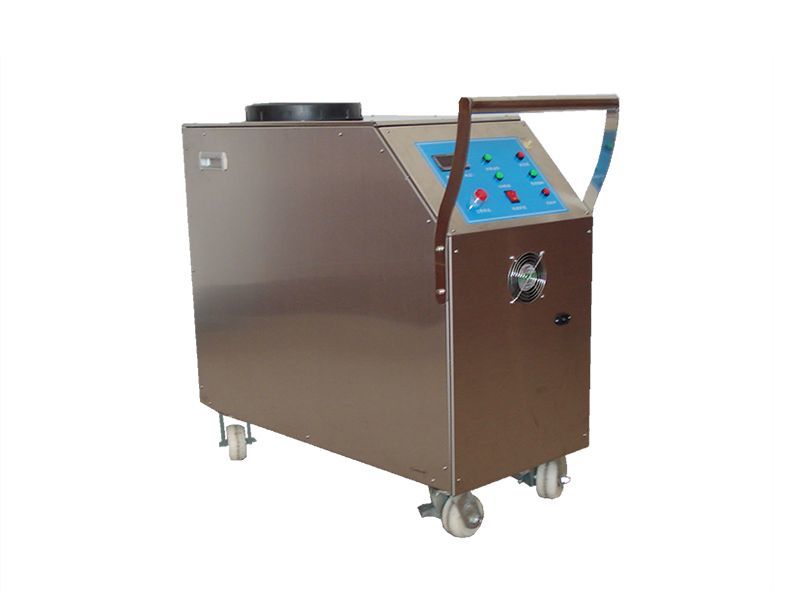
DJ-W2020 Ozone Water Generator
This product is widely used in industries such as pharmaceuticals, healthcare, food processing, drinking water treatment, seafood processing, tourism, entertainment, cosmetics, and poultry farming. It can also be applied for surface disinfection in venues like hotels, restaurants, cafeterias, hospitals, and livestock farms.
If you're interested in our products,Please contact us.
Product Categories
Keywords:
Details
I. Technical Introduction to the DJ-W Series Ozone Water Generator
The DJ-W series ozone water generator is a proprietary patented technology developed by Guangyuan Instrument Factory. This technology uses pure water as its raw material and produces ozone via low-pressure electrolysis, requiring no auxiliary materials or additives whatsoever. The resulting ozone concentration can reach as high as 18-20% (by weight of the released gas). The ozone gas produced is accompanied solely by oxygen, with absolutely no secondary pollution. Thanks to its built-in cooling and moisture-resistant features, this machine does not require additional equipment such as cooling or dehumidification systems. Moreover, this machine is equipped with a built-in, highly efficient gas-liquid mixing technology. By integrating advanced manufacturing practices from Japan and Taiwan, our factory has maximized both mixing efficiency and ozone concentration. Compared with similar products available domestically and internationally, this machine boasts superior ozone mixing efficiency, a compact size, and significant cost savings as well as reduced energy consumption.
Product application scope:
This product is widely used in industries such as pharmaceuticals, healthcare, food processing, drinking water treatment, seafood processing, tourism, entertainment, cosmetics, and poultry farming. It can be applied to the surface disinfection of objects in hotels, restaurants, cafeterias, hospitals, and livestock farms. The duration required for effective sterilization depends on the number of objects to be disinfected. To accelerate the sterilization process, it is recommended to pre-clean the surfaces of objects with clean water. Experimental and research results indicate that a spray duration of 0.5 to 5.0 minutes is sufficient to thoroughly complete the sterilization process.
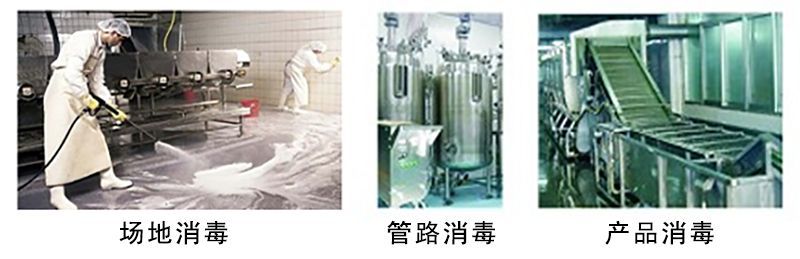
Note: The ozonated water produced by the DJ-W series ozone water generators is a final disinfectant that leaves no residue after disinfection, so there’s no need to rinse again or add other disinfectants.
Product Description and Technical Parameters:
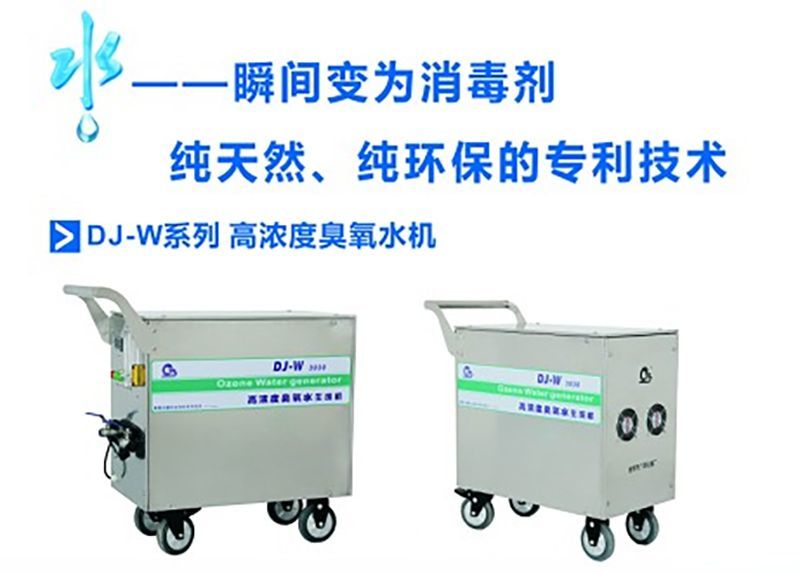
The DJ-W series ozone water generator is a hygienic cleaning and washing product that directly produces ozonated water. It uses a high-speed rotating turbine to create negative pressure, drawing ozone into the space between the turbine and the water. At the same time, the turbine rapidly stirs the ozone and water together, ensuring that the ozone is evenly dispersed throughout the water. The ozonated water can be discharged through the provided hose. This device offers a water flow rate ranging from 300 to 3,000 liters per hour and an ozone concentration of 1 to 8.0 ppm (the actual ozone concentration near the spray nozzle typically ranges from 1.0 to 10.0 ppm). It is suitable for disinfecting buckets, desktops, plates, fresh food, and water tanks; cleaning walls and floors; purifying drainage channels and hoses; as well as treating conveyor belts, utensils, wet surfaces, and CIP equipment. Compatible materials include stainless steel, plastics, wood, concrete, cement, and other similar substances. This product features a built-in, highly efficient gas-liquid mixing system and requires an inlet water pressure no greater than 0.3 MPa.
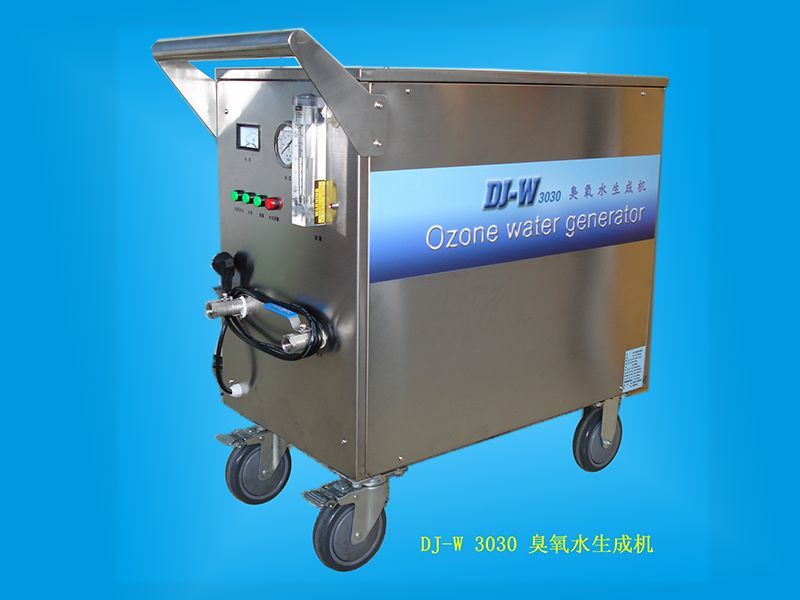
DJ-W3030 Specifications:
Input voltage: 100–220VAC
Input power: 800W
Ozone generation method: PEM low-pressure electrolysis
Ozone output: 2400mg/hr
Ozone concentration: 250–285 mg/L
Ozone water production: 300–1000 L/hr
Outlet water pressure: 0.1–0.3 MPa
Ozone water concentration for application: 2.0–11.0 mg/L
(Other models omitted)
II. Mixing Technology and Innovation of the DJ-W Series Ozone Water Generators
Currently, there are three main methods for preparing and using ozonated water:
1. Aeration Method: This method offers the worst mixing performance, and the resulting overflow gases prevent employees from approaching the operation area. As a result, this method is now rarely used.
2. The Recirculation Method: This method has two primary objectives: A. The ozone water concentration cannot be directly achieved; B. It is used to conserve water resources. However, in routine disinfection practices, the effectiveness of this approach is difficult to guarantee directly—especially when applied to the cleaning of food products. As the water undergoes continuous rinsing, pollutants gradually accumulate, leading to increased ozone consumption and a corresponding decline in disinfection efficacy. Nevertheless, this method can be employed in certain specific situations.
3. Flow-through rinsing method: This method involves directly producing ozonated water by feeding tap water into the system and letting ozonated water flow out—this is... Ministry of Health Disinfection Standards The ozone water disinfection method specified herein represents the optimal way to use ozone water, with the least impact on its effectiveness.
Key technologies and innovative features of the DJ-W series ozone water generator:
1. High-Concentration Ozone Generation Technology. The core component—the PEM electrolysis ozone generator—is a utility model patent owned by our company. It features a modular design, allowing users to combine modules into products of various specifications according to their requirements. The generator’s core electrode is non-consumable, and the water used as a feedstock also serves as a coolant, eliminating the need for external auxiliary equipment. This approach simultaneously addresses two key challenges: automatic balancing of the feedwater and efficient heat dissipation from the generator, thereby ensuring long-term safe operation. The PEM electrolysis ozone generator can produce a high-concentration ozone-oxygen mixture (18–20% by volume) without generating harmful substances such as nitrogen oxides (NOx).
2. Built-in high-efficiency gas-liquid mixing technology: Ozone is mixed with tap water using a gas-liquid mixing pump to produce ozonated water, which is then pumped into a mixing tower for secondary mixing. The mixing tower is equipped with an integrated mixing device that ensures thorough gas-liquid contact. The flow is then split—part of the mixture passes through a flowmeter and a regulating valve for direct use, while the other part returns to the mixing tower via a circulation pipeline, creating a continuous循环 process. This maximizes mixing efficiency and ozone concentration.
3. The prototype testing results indicate that this series of water machines can adjust flow rate and concentration according to different disinfection and sterilization requirements. When the flow rate is increased to 1000 L/h, the ozone mixing efficiency reaches over 95%. The actual ozone concentration near the spray nozzle typically ranges from 1.0 to 9.0 ppm, with a maximum reaching 10.5 ppm. According to a novelty search conducted by scientific and technological experts, no domestic product of similar type has yet reported achieving these performance indicators. Compared with similar products both domestically and internationally, this machine boasts an ozone mixing efficiency that is more than 5% higher, while its volume is only about 50% of that of comparable models, enabling significant cost savings and reduced energy consumption.
III. Comparison with Ozone Equipment Similar to High-Voltage Corona Discharge Devices
A more prominent feature of low-pressure electrolytic ozone application in water treatment is:
●Since the ozone is extracted from pure water, it contains no other impurities such as nitrogen oxides (especially no carcinogenic substances like nitrogen dioxide), does not produce nitrites, and will not affect water quality.
● It has a humidity resistance of up to 90%. The module’s water electrolysis principle is not easily affected by moisture and will not break down.
● The electrode operates at a low power consumption of 3-5V, enabling continuous operation with excellent safety performance and an exceptionally long service life.
●The ozone concentration produced is high (low-pressure ozone: 18–20%; high-pressure ozone: 1–3%). When the same amount of ozone is introduced into water, this method can achieve a higher ozone concentration in the water.
● Low overall operating costs—when achieving the same ozone concentration at the same water flow rate, the operating cost is less than half that of high-pressure equipment.
1. Comparison of Ozone Water Mixers
Comparison Table:
| Comparison items |
Electrolytic ozone |
Corona discharge ozone |
| O₃ raw material |
Made from pure, still water, it has inherent cooling properties. |
Using air or oxygen as raw materials, it requires circulating water cooling or air cooling. |
| Generate ozone |
When the O₃ concentration reaches as high as 18-20%, its solubility in water significantly increases, the diffusion rate accelerates, and the disinfection and sterilization effects are markedly enhanced. |
With an O₃ concentration of 3-6%, its solubility in water is low and its diffusion rate is slow; therefore, it is difficult to prepare high-concentration O₃ water, which limits its range of applications. |
| Ozone water mixing method |
Proprietary secondary mixing technology |
Conventional gas-liquid mixing pumps, air sparging, or recirculation methods |
| Ozone water concentration |
Ozone water with a concentration of 1 ppm or higher can be easily and conveniently prepared, and the concentration can even reach over 10 ppm. Moreover, it is highly stable. |
It is difficult to produce ozonated water with a concentration exceeding 1 ppm, and such water is extremely unstable. |
| Power consumption |
Working input voltage: 220V |
Working input voltage: 380V |
| Existing problems |
We do not have any related issues; for a detailed analysis, please see the next page. |
1. The ozone water has too strong a smell, and the employees can't stand it. 2. Water flows backward, damaging the equipment. 3. The concentration of ozone water is unstable, The above three issues were obtained through our on-site surveys of high-voltage corona customers. |
The specific analysis is as follows:
(1) Why does ozone water produced by the corona discharge method—using air or oxygen as raw materials—have a very strong odor? Moreover, it is difficult to produce ozone water with an ozone concentration exceeding 2 ppm, and such water exhibits extremely unstable concentrations. The specific reasons are as follows:
① The strong odor is due to large amounts of ozone gas that haven't dissolved in the water and have instead escaped into the air.
② The ozone concentration produced by the corona discharge method typically ranges from 3% to 6%, whereas the electrolytic ozone generation method can achieve concentrations as high as 18% to 20%. Due to the higher ozone concentration produced, using the electrolytic method can attain a significantly higher ozone concentration in water when introducing the same amount of ozone.
③ When ozone is used to produce ozonated water, its solubility in water follows Henry’s Law: the higher the ozone concentration, the better its solubility in water. In practical applications, 1 gram of ozone produced by the electrolytic method is equivalent to 3–5 grams when used for water treatment via the corona discharge method. Moreover, the greater the required concentration of ozonated water, the wider the gap between these two methods. Additionally, due to the inherent characteristics of the ozone gas concentration produced by this method itself, it is impossible to directly produce ozonated water with a concentration exceeding 2 ppm.
(2) Why do ozone generators that use the corona discharge method (using air or oxygen as raw materials) experience water backflow, leading to equipment damage, whereas ours don’t?
① Since the corona discharge method produces a relatively large total volume of ozone-containing gas—for example, with a 3 ppm, 3 m³ device—the minimum ozone requirement is 50 g (equivalent to a volume of 23 L). The resulting gas volume can reach as high as 380 L. However, the gas-liquid mixing pump in a 3 m³ system can only handle a maximum gas volume of 300 L. Therefore, it’s impossible to install a controller on the gas line, because excessive pressure buildup in such equipment could lead to pipe damage. Moreover, at the moment the water pump is switched on or off, there’s a backpressure phenomenon in the water flow. Since there’s no control device installed on the gas line, water could directly enter the reaction tube, causing damage.
② For the electrolytic type, only 25 g is required (equivalent to a volume of 12 L), yet the gas produced amounts to only 60 L—far less than the gas volume that the gas-liquid mixing pump can handle. Therefore, we’ve added a controller to the gas line (equipped with a check valve and an overflow port, providing double protection against backpressure from water). Since the overflow port is non-mechanical, it will never suffer any damage whatsoever.
2. Performance and Characteristics of Low-Pressure Electrolysis Type
(1) The ozone concentration produced is several times higher by weight compared to the high-voltage corona method (up to 20%).
(2) The ozone gas produced contains no nitrogen oxides and no carcinogenic substances.
(3) It employs the low-voltage electrolysis principle (3–5V), eliminating any risk of electrical hazards. It does not generate electromagnetic waves or noise, and when operating alongside other precision instruments, it does not cause interference.
(4) The ozone generator uses pure water as its gas source and does not require an oxygen source or any additional auxiliary equipment beyond the high-pressure ozone generator itself during operation. It is easy to operate and safe and reliable.
(5) Low electrode wear, continuous operation capability, and ultra-long service life.
(6) It is unaffected by the working environment and temperature, and has a humidity resistance of up to 85%.
(7) The pure water self-circulation cooling system eliminates the risk of overheating caused by continuous operation of the equipment.
(8) Due to the high ozone concentration generated, using this method with the same amount of ozone introduced into water can achieve a higher ozone concentration in the water.
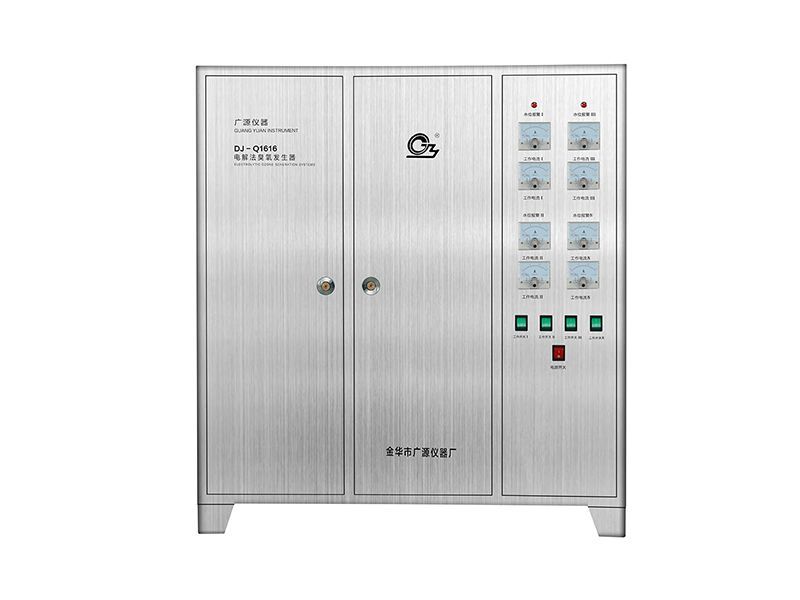
3. Performance Indicators and Comparison of DJ-Q Type Electrolytic Ozone Generators vs. Air (Oxygen)-Discharge Ozone Generators
| Performance metrics |
DJ-Q Type Electrolytic Method |
Corona discharge method |
|
| Panel-style |
Tubular |
||
| Air source |
Deionized water |
Air |
Air or oxygen |
| Air source dew point/℃ |
0-35 |
-60 |
-60 |
| Cooling method |
— |
Water-cooled or air-cooled |
Water-cooled |
| Operating voltage |
3-5V |
7.6~20 kV |
15~19 kV |
| Power frequency / Hz |
50-60 |
50-500 |
60 |
| Power consumption/kW·h/kg O₃ |
50 |
20-30 |
15-19 |
| Dielectric |
Deionized water |
Ceramic sheet (plate) |
Glass tube |
| Air chamber pressure/kPa |
— | 7-86 |
20-100 |
| Ozone concentration/% (by weight) |
18-20 |
1-3 |
1-3 (air source) |
| Work environment humidity/% |
≤90 |
≤40 |
≤50 |
| Generator electrode life/h |
≥10000 |
≤1000 |
≤3000 |
| Gas composition of the output |
Oxygen + Ozone |
Nitrogen + Ozone + Oxygen + Nitrogen Oxides |
Nitrogen + Ozone + Oxygen + Nitrogen Oxides |
| Pollution status |
None |
Nitrogen oxides and electromagnetic waves |
Nitrogen oxides and electromagnetic waves |
| Related during use Equipment |
No need |
Circulating cooling towers, air dehumidifiers, oil-free pumps |
Circulating cooling tower, air dehumidifier (oxygen cylinder or oxygen concentrator), oil-free pump |
| Operating cost/h |
0.09 yuan |
0.15 yuan |
0.13 yuan (air source) |
Get a quote
Related Products


Nationwide sales hotline available 24/7
Address: Building 12, No. 168 Kechang Street, Qiubin Subdistrict, Wucheng District, Jinhua City, Zhejiang Province
E-mail:
Tel:
在线客服添加返回顶部
右侧在线客服样式 1,2,3 1
图片alt标题设置: Guangyuan Environmental
表单验证提示文本: Content cannot be empty!
循环体没有内容时: Sorry,no matching items were found.
CSS / JS 文件放置地